


ADVERTISEMENT
When iGaming powerhouse Relax Gaming needed a new flagship Malta office to match its rapid growth and global ambition, the brief was as inspiring as its top-floor location. The catch? A timeline measured in weeks, not months.

Perit Angie Sciberras talks to Sarah Muscat Azzopardi about the four-stage programme that delivered a workplace of precision and understated confidence, proving that speed and quality can indeed elevate one another.
For Perit Angie Sciberras, the brief for Relax Gaming’s new Malta headquarters was compelling from the outset. Here was a company on a steep upward trajectory – an international team with hubs from Estonia to Gibraltar – in need of a flagship workplace that could not only accommodate its rapid expansion but also embody its ambitious spirit.
“I was immediately drawn to the Relax Gaming project because their brief carried real momentum and ambition,” she begins. “I saw the chance to create a flagship workplace that could reflect that global presence while evolving with their rapid growth.”
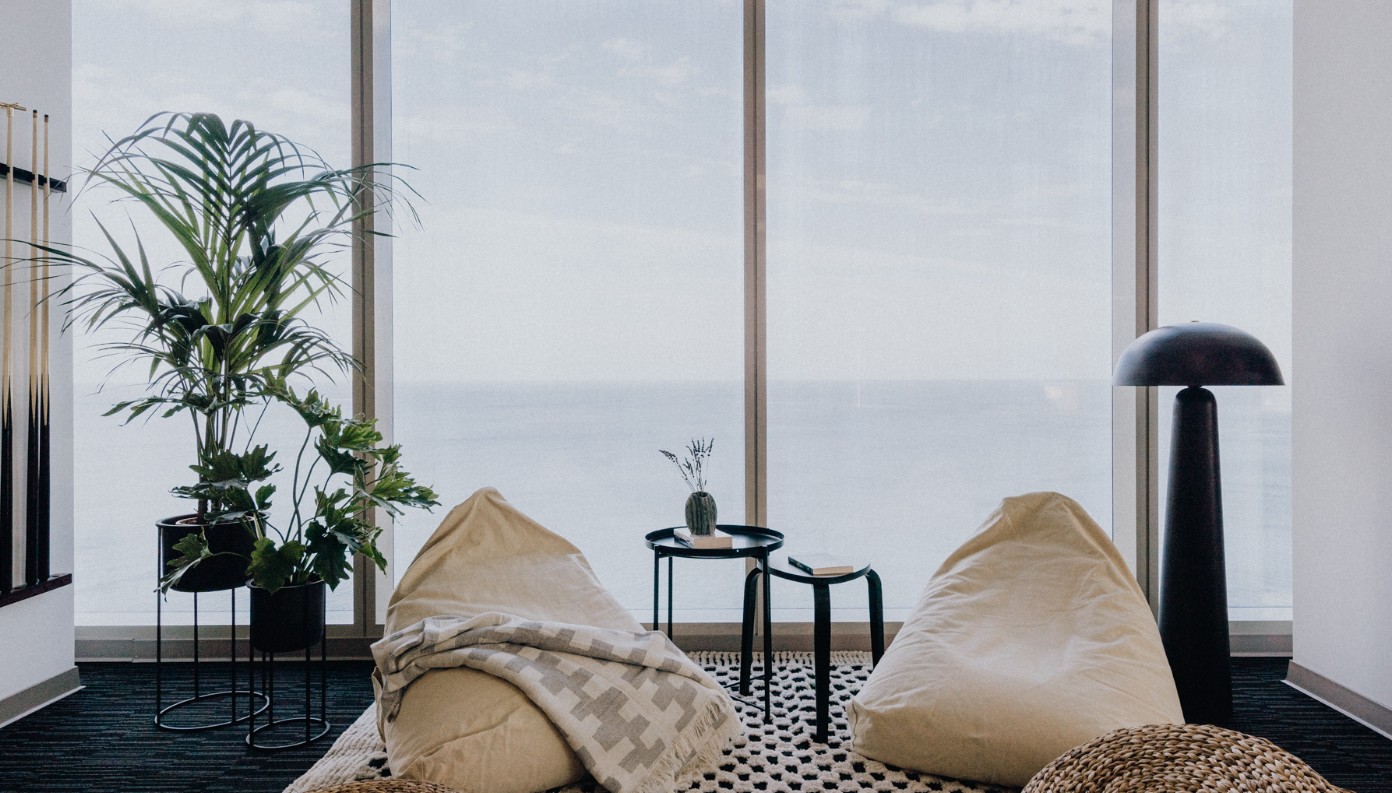
The chosen location was a statement in itself. Occupying the top floor of the Tigné Centre, the space offered breathtaking views across the Mediterranean and a palpable sense of arrival. “The location itself was inspiring,” she notes. “The top floor offered panoramic views, abundant natural light and a sense of elevation that mirrored Relax Gaming’s aspirations.”
It was a building Angie knew intimately, having worked on extensive projects within the office block in 2017 and 2018. This prior experience proved invaluable, allowing her team to bypass the typical learning curve. “That prior experience meant we could move with clarity and conviction from the very start,” she explains, “delivering a design that was both ambitious and grounded in practical knowledge of the building.”
This running start was critical, because the project’s primary constraint, she reveals, was its timeline. “Ordinarily, a relocation of this scale should be planned over a year or more, but Relax Gaming needed the space ready far sooner,” Angie states. The challenge was to deliver a high-quality, bespoke environment without the luxury of time.
Compromise was not an option. Instead, the team utilised a philosophy of focused intervention and disciplined execution. “Rather than compromise, we responded with precision and restraint, focusing on what would truly move the needle – light, acoustics, identity, and flow – while working with the existing base build wherever possible. That philosophy shaped a fast-track, four-stage programme that delivered quality at speed,” the architect maintains.
The first stage was a rapid-fire concept phase, condensing months of work into a matter of weeks. Through intensive engagement with leadership and teams, a utilisation study and a streamlined decision-making framework, the core design was locked in with remarkable efficiency. “We set up a decision matrix so choices could be made in one meeting instead of five,” Angie recalls. “That clarity early on was critical to keeping momentum without losing design integrity.”
Secondly, the strategy was to work with the building, not against it. By reusing existing mechanical, electrical and plumbing routes, as well as core and perimeter planning, the budget and timeline could be focused on high-impact areas. “We designed with the building, not against it,” she affirms. This allowed the team to “focus spend where it mattered most: acoustics, lighting, brand moments, and collaboration zones.”
Procurement and design ran in parallel – a logistical necessity to meet the deadline. Long-lead items were secured early, and a network of trusted local fabricators was engaged to maintain quality under pressure. The final, crucial stage was a relentless focus on governance and delivery.
“Weekly meetings with the client ensured decisions happened at the table; we maintained a live risk register, sequenced works for early occupation of critical areas and applied zero-surprise cost control,” Angie says. The outcome is a testament to this rigorous approach: a workplace perfectly tailored to its user, delivered at pace but with a finish that feels considered and refined. As she puts it: “It’s proof that with discipline, collaboration and experience, speed and quality don’t just coexist – they elevate one another.”
With the foundations of the process in place, the team turned to translating Relax Gaming’s unique culture into a physical space. The brand’s ethos of integrity, calm confidence and innovation called for a design language that was expressive without being loud. “We began with a timeless base: a neutral palette, precise lighting and textured materials,” Angie describes. “From there, identity was dialled up in moments that mattered.”
This manifests in subtle but distinctive brand integrations. The company’s dotted ‘X’ logo, for instance, was embedded into custom acoustic panels – its form rendered in subtle perforation and relief that shifts across different zones. Gentle curves in the detailing and gradient-inspired textures further soften the space, while discreet LED lines trace circulation routes, guiding movement almost subconsciously.
Nowhere is the fusion of form and function more apparent than in the Brainstorming Room. Designed as a direct architectural response to the fluid, non-linear nature of creative work in the gaming industry, it is a space built for adaptation. “Ideas rarely unfold in straight lines – especially in gaming, where creativity thrives on energy, experimentation and sudden pivots,” the architect observes.
Here, everything is movable. Tables glide on castors, partitions can be repositioned with ease, and entire walls become canvases with magnetic whiteboards. “Within minutes, the room can open wide for a town-hall sprint, fold inward for an intimate huddle or reorient entirely to host a hybrid session with teams dialling in from abroad,” she adds. Light and sound are treated as dynamic, adjustable tools to match the energy of the room, while the integrated technology is designed to be frictionless and intuitive. “It’s more than a meeting room; it’s a catalyst for ideas in motion.”
This principle of providing diverse, purposeful environments extends throughout the workspace. Angie is clear that “creative teams don’t work in one gear,” and the design reflects this by offering an ecosystem of zones tailored to different modes of work and rest.
The kitchen and dining area acts as a warm, welcoming social anchor with hospitality-grade finishes, while the Games Room is designed for “friendly rivalry with a purpose”, sparking camaraderie and flattening hierarchies. In direct contrast, the Oasis provides a crucial counterpoint. “It’s a space for reset,” the architect explains. “Softer acoustics, biophilic cues and warmer light give people a refuge for solo work, decompression or neurodiverse needs. It protects focus as much as it supports well-being.”
Underpinning the entire design is a deep commitment to biophilia and sustainability. Greenery is not an afterthought but a “lifeline, threaded through circulation routes, work zones and quiet areas” to reduce stress and improve cognitive function. This philosophy complements the building’s LEED-certified status, which the design aims to amplify rather than overwrite. Elsewhere, the team specified low-VOC finishes (containing a reduced amount of chemicals), FSC-certified timber, and recycled-content furniture, and worked with local fabricators to reduce the project’s carbon footprint. For Angie, sustainability is about intelligent restraint – knowing when reuse is smarter than redesign.
Looking at the broader iGaming industry, the architect sees the Relax Gaming project as an embodiment of the future of workspace design. The new paradigm is “hybrid-native, flexible and employee-first”. This means moving away from the outdated one-desk-per-person model towards a more intentional, data-informed approach that plans for different work modes.
“Offices now need high-performing ‘me spaces’ for deep focus, collaboration areas for sprints, social hubs for energy, and calm rooms for reset – each tuned for neurodiversity,” she concludes.
With technology, well-being, and sustainability as central pillars, the ultimate measure of success is simple: “How well does this environment help people do their best work?” For the Relax Gaming team in Malta, this new workspace is more than just a new office. As Angie proudly states: “It’s a framework for how creative teams in Malta and beyond will thrive tomorrow.”
This article first appeared in the iGaming Capital 2026 edition. For more information on the iGaming Capital 2026 edition or on www.iGamingCapital.mt, get in touch via email on info@contenthouse.mt or on +356 2132 0713. Additionally, readers can visit the iGaming Capital portal at www.iGamingCapital.mt to stay updated on the latest developments in Malta’s iGaming industry.
Featured Image:
Relax Gaming offices / angiethearchitect.com


Continue Reading
Continue Reading

Aviator creator David Natroshvili to attend NEXT Summit Valletta
Spribe is best known for developing the popular crash game Aviator

Expansion
Tipico becomes official partner of Malta’s national football team
The first major moment in the partnership will be Malta’s UEFA Nations League playoff match against Luxembourg tomorrow
Expansion
Dhalia Real Estate celebrates excellence at Annual Awards Night at The Phoenicia
Dhalia Real Estate is honouring the people, performances, and shared values that continue to shape the company’s success
Expansion
‘Yes, I hacked you’ – German hacker claims to be behind Malta Gaming Authority security breach
Lilith Wittmann teased ‘upcoming releases concerning organised crime networks supported by countries like Malta’
Expansion
IZIGROUP: From market leadership to international ambition
Over recent years, IZIGROUP has been ‘methodically laying the groundwork for international growth,’ says Founder and CEO Johann Schembri